리소스로 돌아가기

리워드형 광고 심층 분석: 성과 인사이트와 2026년 전망

November 11, 2025

목차

Rewarded ads by the numbers: 5 key stats

  • 9 in 10 players interact with rewarded ads
  • Ad engagement rates are consistently higher
  • Retention can go up 3.5x with rewarded ads
  • Rewarded advertising can increase IAPs
  • Rewarded ads have the highest eCPM 

What’s next? Trends shaping the future of rewarded ads

매월 인사이트가 담긴 Loot Box를 이메일로 바로 받아보세요!

구독
퍼블리셔

You can’t walk through a mobile gaming conference these days without seeing rewarded ads everywhere. Everyone’s talking about engagement, retention, and happier players – and the numbers seem to back it up. Rewarded ad formats are climbing fast in performance rankings and are becoming a real leader in mobile UA strategies. 

But with all the enthusiasm, it’s fair to ask: is this hype truly justified? Are rewarded ads really outperforming other formats, or are we seeing a trend that will be taken over by something else by 2027? 

In this article, we’ll unpack 2025’s rewarded ads performance data, explore what’s driving the success of rewarded advertising, and look at what’s next.

👀 Related reading: What is rewarded advertising and why does it work?

Rewarded ads by the numbers: 5 key stats

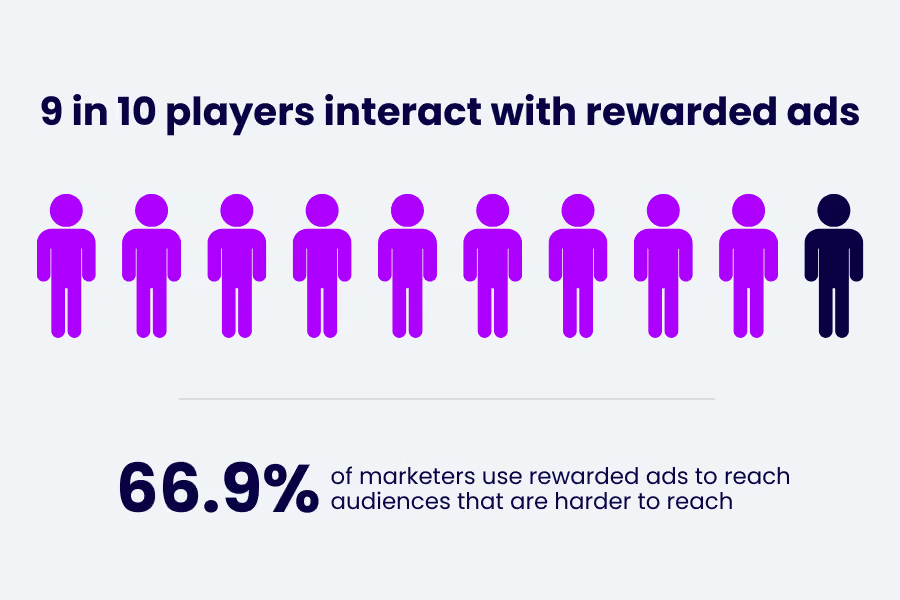
9 in 10 players interact with rewarded ads

rewarded ads stats
Source: Emarketer

We all know that ad fatigue is real. You’ve probably experienced it too.

When a game or an app has too many ads, we tend to respond negatively, often by uninstalling the app altogether. Rewarded advertising goes against the trend here. 

In a recent research carried out by Emarketer and Discord, 65% of US marketers agreed that users prefer rewarded ads, and 46.3% of them say that rewarded ads make users feel more in control. In fact, according to Digiday, 85% of mobile game players enjoy in-game rewards, and 9 in 10 actively interact with an ad to get the reward. Being an opt-in ad format, rewarded advertising is perceived more positively because users choose to interact with the ad; it’s not forced on them.

Thanks to this, 66.9% of marketers also use rewarded advertising to reach those audiences that are typically harder to reach (Emarketer).

Rewarded ad engagement rates are consistently higher

rewarded ads type
Image source: Game UI Database

Overall, we’ve seen that rewarded ads have a higher engagement rate compared to other ad formats. But they perform even better when they’re placed right and at the right time.

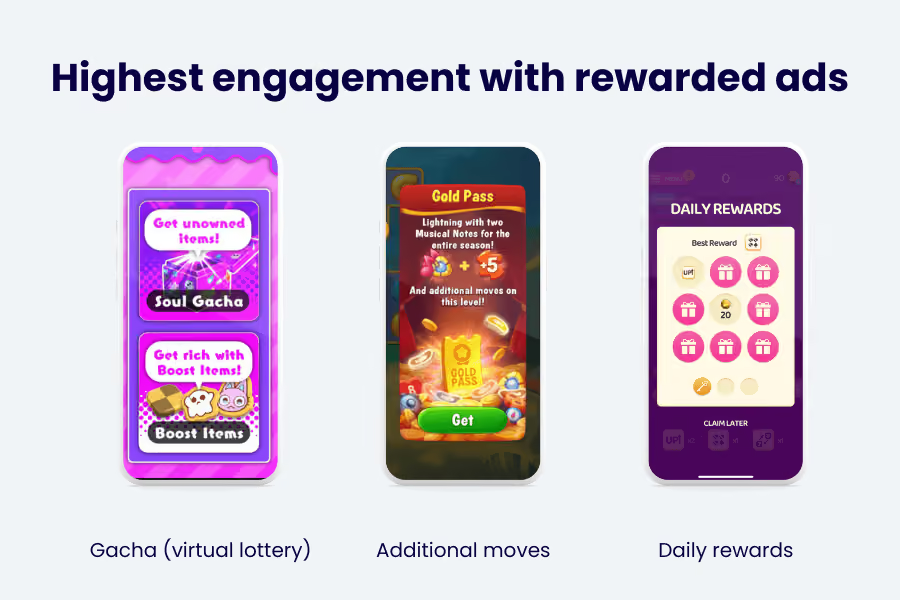
In its Mobile Growth and Monetization Report, Unity discovered that the rewards that drive the highest level of engagement are:

  • Gacha (virtual lottery), 31.1%. Random rewards trigger curiosity and excitement, encouraging players to engage more often.
  • Additional moves, 30.5%. Additional moves help users when they are about to lose a level. Offering a reward in that exact moment increases engagement.
  • Daily rewards, 30.3%. Daily rewards incentivize players to return every day and stay active over time.

They have also found that there are certain types of games where engagement with rewarded ads is even higher than usual

Here, we need to make a difference between rewarded video ads and offerwalls. Rewarded video ads perform better in:

  • Word puzzle games
  • RPGs
  • 캐주얼 게임

On the other hand, offerwalls suit best:

  • Strategy games
  • City builders and management games
  • Games with strong social elements

When the rewards are valuable and timed right, players will opt in more often.

Retention can go up 3.5x with rewarded ads

Together with engagement, rewarded ads also show more positive retention rates. At Mistplay, we’ve worked with hundreds of mobile games and noticed that rewarded ad campaigns tend to have a strong effect on longer retention, from day 7 to day 30

If we look at industry averages, we see that retention rates from D7 to D30 are already quite low and then decrease drastically. For example, simulation games have an average D7 retention rate of 2.4%, while D30 is 0.50%. Similarly, for puzzle games, D7 retention sits at 4.5% and 1.20% for D30.

From our internal data, games that have implemented an offerwall and launched a rewarded ad campaign, see much higher retention rates (see, for example, our case studies on Hyper Hippo, 707 Interactive and Mystery Tag).

Let’s compare them below:

카테고리 Average D7 Average D30 D7 with offerwall D30 with offerwall
시뮬레이션 2.4% 0.50% 22.4% 7.7%
퍼즐 4.5% 1.20% 25.2% 6.4%
캐주얼 3.3% 0.70% 22.1% 8.2%
RPG 2.1% 0.43% 6.7% 4.1%
카지노 5.5% 1.90% 17.8% 6.15%

This data is confirmed by other sources as well, with Unity finding that users who convert via an offerwall have 2-7x higher retention compared to non-offerwall users:

  • 45.8% higher retention rate on D1.
  • 86.1% higher retention on D7.
  • 71.7% higher retention on D14.

An ironSource study also showed that 30-day retention steadily increased with each rewarded video view, ranging from about 53% retention with just one ad view up to 68% with multiple views (Digiday). 

In other words, users who engage with even a single rewarded video are far more likely to still be playing a month later.

Rewarded advertising can increase IAPs

Rewarded ads give users extra lives, in-app currency, or free trials in exchange for their time. A perfect monetization method for non-paying users.  But what might come as a surprise is that rewarded advertising can actually turn these users into paying ones.

In fact, users who engage with rewarded ads are 4 times more likely to make in-app purchases compared to those who don’t (Unity). This is because players coming from rewarded ad formats (especially offerwalls) are often of higher quality. So they show higher engagement, retention and LTV.

Unity shows that players’ spending increases significantly after engaging with an ad, with an average increase of +326% and peaks of +500%! We noticed it, too. After implementing the Mistplay Audience Network and a rewarded campaign, ActionFit had a +18% increase in IAPs on iOS.

Rewarded ads have the highest eCPM 

Last but not least, rewarded advertising isn’t just great for UA, but for monetization as well. The trend we’re seeing shows three main benefits:

  • High eCPMs. For example, rewarded video ads in the United States have an average eCPM of $15.15, while interstitial ads sit at $12.65. And if we look at offerwalls, the numbers are much higher, with an average of $530.
  • Higher ARPDAU. In recent projects, we saw ARPDAU rise by +30% and +66% after implementing rewarded advertising campaigns.
  • Happier users. Mobile gamers prefer rewarded ads to interstitials, 4-to-1.

👀 관련 기사: 모바일 앱 추적에 필수적인 8개의 사용자 리텐션 지표

What’s next? 3 trends shaping the future of rewarded ads

As you may now understand, rewarded advertising is here to stay and flourish. We can expect it to gain even more ground, with applications that go beyond mobile gaming. Let’s take a look at some possible future trends. 

AI-powered personalization

Artificial intelligence is going to make rewarded advertising even more targeted and dynamic. With the help of AI, advertisers may tailor the type of reward or timing of an ad to individual users in real-time. For example, algorithms could determine which reward will get the best response from a user and then adjust offers to suit. AI can also optimize when to show an ad. The goal is to maximize engagement and LTV by making the experience feel personal. 

Beyond gaming: New uses for rewarded ads

Today, the majority of rewarded ads reward players with virtual currencies, such as in-app currency, extra lives, bonuses, etc. However, there’s an ongoing trend that will likely become more popular: real-world rewards, such as gift cards, discount coupons, or real money payments. 

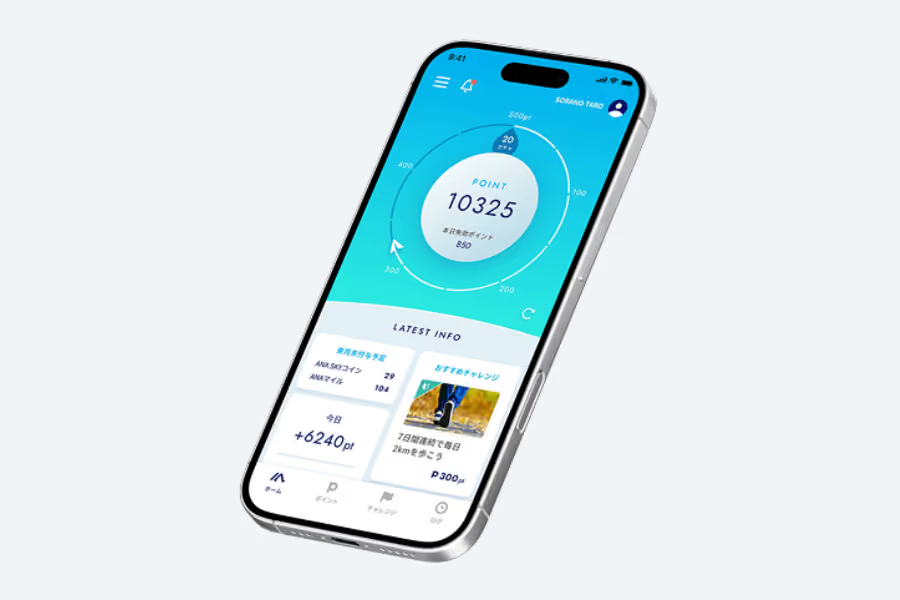
An example is Ana Group, a Japanese airline, which has a loyalty app that allows users to collect air miles while moving. Recently, they also integrated the LoyaltyPlay gaming hub and added a “Game Bonus” section, which rewards users with the same miles, but for playing games!

ana group, rewarded ads
The homepage of Ana Pocket, part of Ana Group


If, until now, rewarded advertising was almost exclusive to mobile games, now we can expect different industries and app genres to take advantage of rewarded ads. 

‍‍

Extended campaign windows

This point especially applies to offerwalls and playtime-based rewards.

Playtime-based campaigns reward users for the time they spend playing a game, rather than for the tasks accomplished.

While today most of the rewarded campaigns last around 30 days, there’s a new tendency for longer campaigns, like 60, 90, or even 128 days!

This approach has a double result:

  • On the one hand, users can get a bigger reward than usual.
  • On the other hand, longer campaigns mean higher retention rates and LTV for game developers. 

결론

Rewarded ads have become a key growth lever for both advertisers and developers. The combination of user choice, engagement, and retention makes this format one that balances user satisfaction with business goals.

Looking ahead, we’ll see even greater innovation. 

AI will personalize when and how rewards appear, gamified formats will drive deeper session times, and real-world rewards will expand rewarded ads into lifestyle, fintech, loyalty apps, and more.

Mistplay can help you take the next step in rewarded advertising. If you’re looking for new ways to advertise your app or game by tapping into the loyalty ecosystem and reaching new engaged users, reach out to us, and let’s discuss how to leverage this leading strategy for your app.